Capital Raising, ESG Investing, Risk Management, and Financial Modeling: Building Sustainable Financial Strategies
Written by Jayan Selim
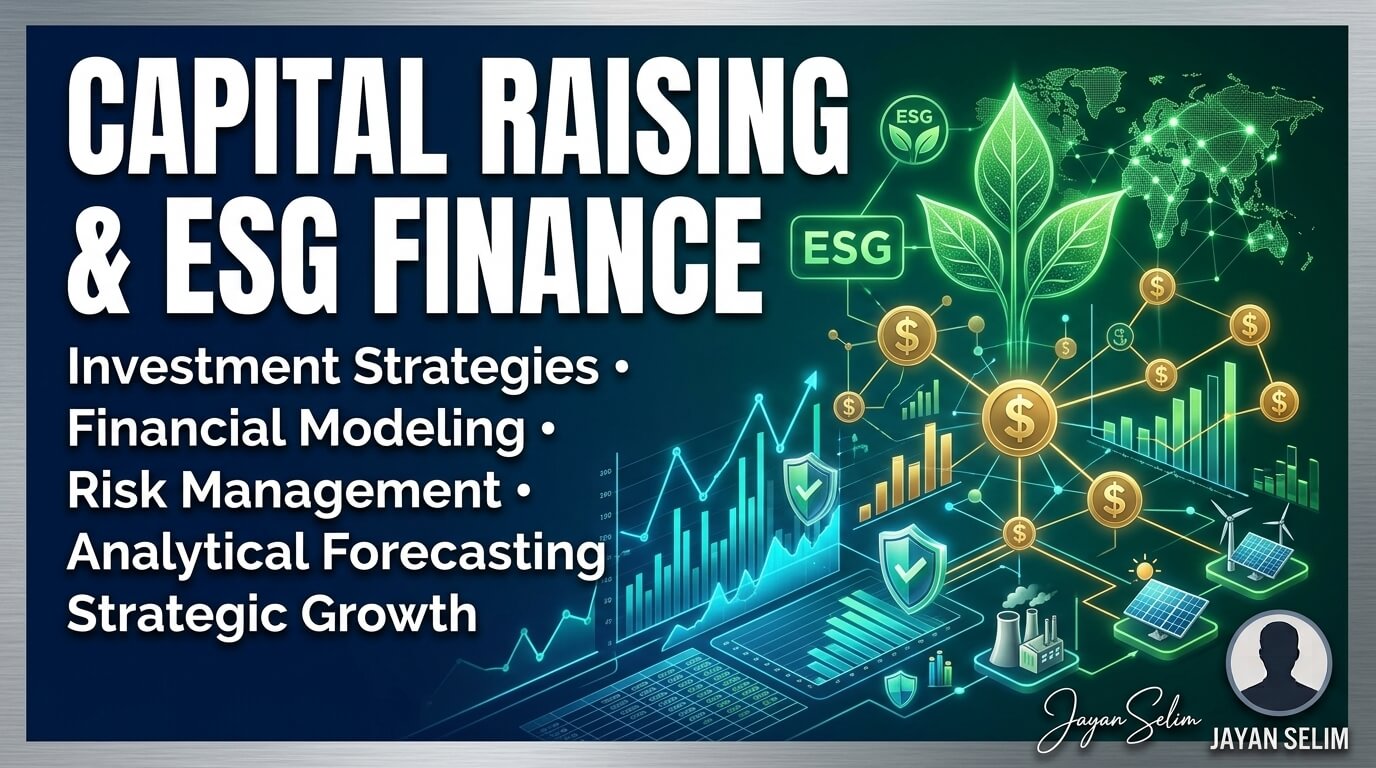
Modern organizations need more than access to capital to achieve long-term success. They need effective capital raising strategies, responsible investment approaches, financial risk management, and accurate financial modeling to support sustainable growth and informed decision-making.
As sustainability and responsible investment become increasingly important across industries, organizations are also considering environmental, social, and governance factors when evaluating investment opportunities. Combining capital raising, ESG investing, risk management, and financial modeling can help organizations strengthen financial resilience while creating long-term value.
1. Capital Raising Strategies and ESG Investing
Securing funding is one of the most important challenges for organizations seeking growth and expansion. Capital Raising Strategies provide structured approaches for attracting investors, obtaining financing, and supporting business development.
These strategies may include:
- Venture capital
- Angel investment
- Crowdfunding
- Private equity
- Strategic partnerships
At the same time, ESG Investment Strategies are becoming increasingly relevant as investors consider sustainability alongside financial performance. ESG focuses on Environmental, Social, and Governance principles and encourages organizations to demonstrate responsible practices while creating financial value.
Funding Strategies
Organizations can strengthen their financial foundation by focusing on:
- Identifying suitable funding sources
- Developing compelling investor presentations
- Building sustainable business models
- Establishing long-term financial objectives
ESG Investment Strategies
ESG-focused investors may consider:
- Environmental sustainability
- Social responsibility
- Corporate governance
- Long-term value creation
These principles can also be relevant to industries such as energy, oil and gas, infrastructure, engineering, and environmental projects, where sustainability and long-term investment considerations can influence financial decisions.
2. Financial Risk Management and Financial Modeling
Effective financial planning requires organizations to identify and manage potential uncertainties. Risk Management in Finance provides a structured framework for recognizing financial threats, evaluating their potential impact, and developing strategies to reduce losses.
Effective risk management can support:
- Better financial decision-making
- Greater financial stability
- Improved investor confidence
- Stronger organizational resilience
The Role of Financial Modeling
Financial Modeling Techniques help organizations create analytical models that forecast business performance under different scenarios.
Financial models can be used for:
- Revenue and expense forecasting
- Investment opportunity evaluation
- Financial risk measurement
- Strategic decision-making
These techniques can be particularly valuable in industries where projects involve significant investment and uncertainty, including oil and gas, aviation, telecommunications, infrastructure, energy, and engineering projects.
When financial risk management is combined with financial modeling, organizations can prepare more effectively for uncertainty while improving both operational and financial performance.
3. Building Sustainable Financial Success
Long-term financial success depends on balancing investment opportunities with responsible financial planning.
Organizations that combine Capital Raising Strategies, ESG Investment Strategies, Financial Risk Management, and Financial Modeling can strengthen their ability to attract investment, manage uncertainty, and support sustainable growth.
Organizations should focus on:
- Aligning funding strategies with organizational objectives
- Incorporating ESG principles into investment decisions
- Continuously monitoring financial risks
- Using financial models to improve forecasting
- Supporting data-driven financial decisions
This approach can also support investment planning in sectors such as renewable energy, environmental projects, oil and gas, aviation, telecom infrastructure, and other capital-intensive industries.
Written by Jayan Selim.