Enhancing Workplace Productivity Through Cognitive Performance and Effective Prioritization
Written by Jayan Selim
Workplace productivity is influenced by more than the amount of time professionals spend working. Cognitive Performance Improvement, Task Prioritization Strategies, Work-Life Balance Optimization, and Professional Effectiveness Skills work together to improve focus, decision-making, efficiency, and long-term professional success.
By strengthening cognitive abilities, organizing responsibilities effectively, maintaining a healthy work-life balance, and continuously developing professional skills, individuals can improve their performance while supporting sustainable career growth.
1. Cognitive Performance Improvement and Effective Task Prioritization
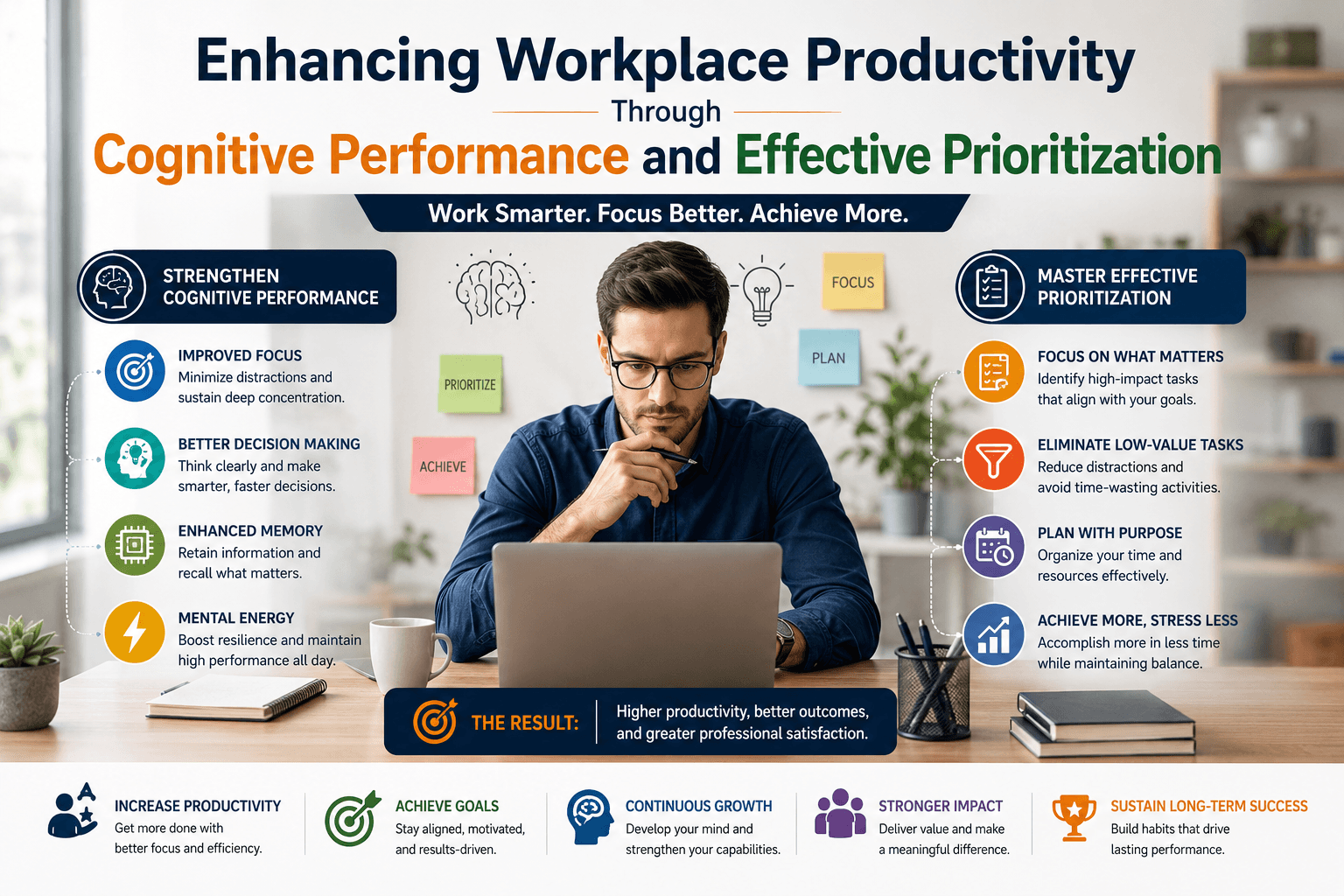
High-performing professionals understand that productivity begins with mental clarity. Cognitive Performance Improvement focuses on enhancing concentration, memory, problem-solving abilities, and decision-making to maximize workplace performance.
However, strong cognitive abilities become even more valuable when combined with Task Prioritization Strategies. Prioritizing responsibilities allows individuals to focus on high-impact activities while minimizing distractions and unnecessary workload.
Cognitive Performance Improvement
Improving cognitive performance helps professionals by:
- Enhancing focus and concentration
- Strengthening critical thinking and decision-making
- Improving memory retention
- Increasing adaptability in complex work environments
Task Prioritization Strategies
Effective prioritization enables individuals to:
- Identify high-value tasks
- Allocate time efficiently
- Reduce unnecessary stress
- Meet deadlines consistently
By integrating Cognitive Performance Improvement with Task Prioritization Strategies, professionals can improve efficiency while maintaining consistent performance.
2. Work-Life Balance Optimization and Professional Development
Sustained productivity requires more than working longer hours. Work-Life Balance Optimization encourages professionals to create healthy boundaries between personal and professional responsibilities, helping reduce burnout while improving overall well-being.
At the same time, developing Professional Effectiveness Skills enables individuals to communicate clearly, collaborate efficiently, solve problems, and lead with confidence.
Professional effectiveness supports long-term career growth by helping individuals:
- Strengthen communication and teamwork
- Improve leadership capabilities
- Make informed decisions
- Adapt to changing workplace demands
When combined, Work-Life Balance Optimization and Professional Effectiveness Skills create a healthier and more productive work environment that benefits both employees and organizations.
3. Building Long-Term Professional Success
Organizations and professionals achieve the best results when productivity is supported by structured personal development.
Combining Cognitive Performance Improvement, Task Prioritization Strategies, Work-Life Balance Optimization, and Professional Effectiveness Skills helps individuals perform at their highest potential while maintaining long-term well-being.
To build sustainable professional success, individuals should focus on:
- Strengthening cognitive abilities through continuous learning
- Prioritizing tasks based on importance and impact
- Maintaining a healthy balance between work and personal life
- Continuously developing professional and interpersonal skills
These principles can also support professionals working in demanding fields such as engineering, aviation, telecommunications, oil and gas, health and safety, and technical operations, where focus, decision-making, adaptability, and effective prioritization are particularly important.
Written by Jayan Selim.