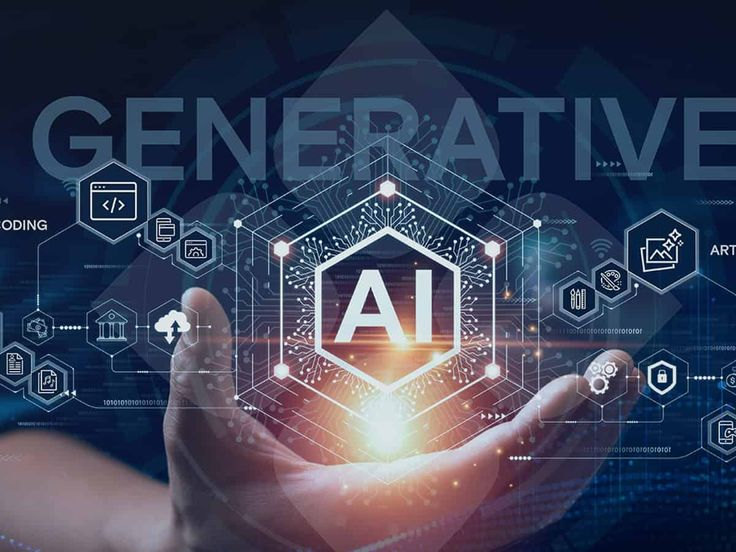
Generative AI: The Most Advanced Methodology for Building Predictive Models
Learn how Generative AI, deep learning, and machine learning power advanced predictive models. Discover how AI-driven forecasting supports automation and smarter decision-making.
Generative Artificial Intelligence (Generative AI) has emerged as one of the most powerful technologies shaping the future of predictive modeling and data-driven decision-making. Unlike traditional artificial intelligence systems, which focus mainly on classification and pattern recognition, Generative AI is capable of creating new and original outputs based on learned data patterns.
These outputs may include text, images, music, software code, and advanced analytical predictions—making Generative AI a transformative tool across multiple industries.
What Is Generative AI?
Generative AI is a branch of artificial intelligence that learns from massive datasets to generate new content that closely resembles real-world data. It works by identifying deep patterns, structures, and relationships within data, then using this understanding to produce new outputs rather than simply analyzing existing information.
This capability distinguishes Generative AI from traditional AI models, which typically rely on predefined rules and historical classification methods.
The Role of Deep Learning in Generative AI
The true power of Generative AI comes from deep learning models. Deep learning is an advanced subdivision of machine learning that uses multi-layered artificial neural networks, inspired by the structure of the human brain. These networks automatically learn complex relationships from extremely large volumes of data.
Deep learning enables machines to perform human-like tasks, including:
Image recognition
Natural language processing (NLP)
Speech recognition
Autonomous systems
Generative content creation
Technologies such as Large Language Models (LLMs), Generative Adversarial Networks (GANs), and image-generation systems like DALL·E are all built on deep learning architectures.
Machine Learning as the Foundation
Deep learning itself operates under the broader field of machine learning. Machine learning is a core domain of artificial intelligence that allows systems to:
Learn from data
Identify patterns and trends
Improve performance through experience
Make predictions without explicit programming
Machine learning models are trained using large datasets, enabling them to detect correlations between variables and produce increasingly accurate outcomes over time.
The Importance of Data Science
Machine learning relies heavily on data science, an interdisciplinary field that combines statistical analysis, scientific methodologies, algorithms, and computational systems. Data science provides the analytical foundation needed to train machine learning systems and design effective predictive models. Without high-quality data science practices, predictive accuracy and model reliability cannot be achieved.
Predictive Models Explained
Predictive models are analytical and statistical tools that use historical and real-time data to forecast future outcomes or behaviors. These models support organizations by enabling:
Risk assessment
Demand forecasting
Customer behavior prediction
Operational optimization
Predictive modeling has become essential in modern decision-making environments where uncertainty and complexity are high.
Applications of Predictive Models
Predictive models play a critical role across many sectors, including business and sales forecasting, financial risk detection, healthcare diagnostics, supply chain management, and industrial automation. Through predictive analytics, organizations can move from reactive decision-making to proactive strategic planning.
Predictive Models and Automation
One of the most powerful outcomes of predictive modeling is automation. When predictive models are integrated into automated systems, organizations achieve:
Higher operational efficiency
Faster decision-making
Reduced costs
Improved accuracy
Scalable performance
Why Generative AI Is the Best Methodology for Predictive Models
Generative AI represents the next evolution of predictive modeling. Unlike traditional predictive systems, Generative AI can simulate multiple future scenarios, learn complex nonlinear relationships, generate adaptive forecasts, and continuously improve through deep learning.
By combining data science, machine learning, and deep learning, Generative AI delivers more dynamic, accurate, and intelligent predictive models.
Conclusion
Generative AI is reshaping how predictive models are built, trained, and deployed. Powered by deep learning, supported by machine learning, and driven by data science, it enables organizations to predict outcomes with greater accuracy and automate decisions more effectively. As industries continue to embrace digital transformation, Generative AI stands at the center of intelligent forecasting, automation, and future-ready decision-making.