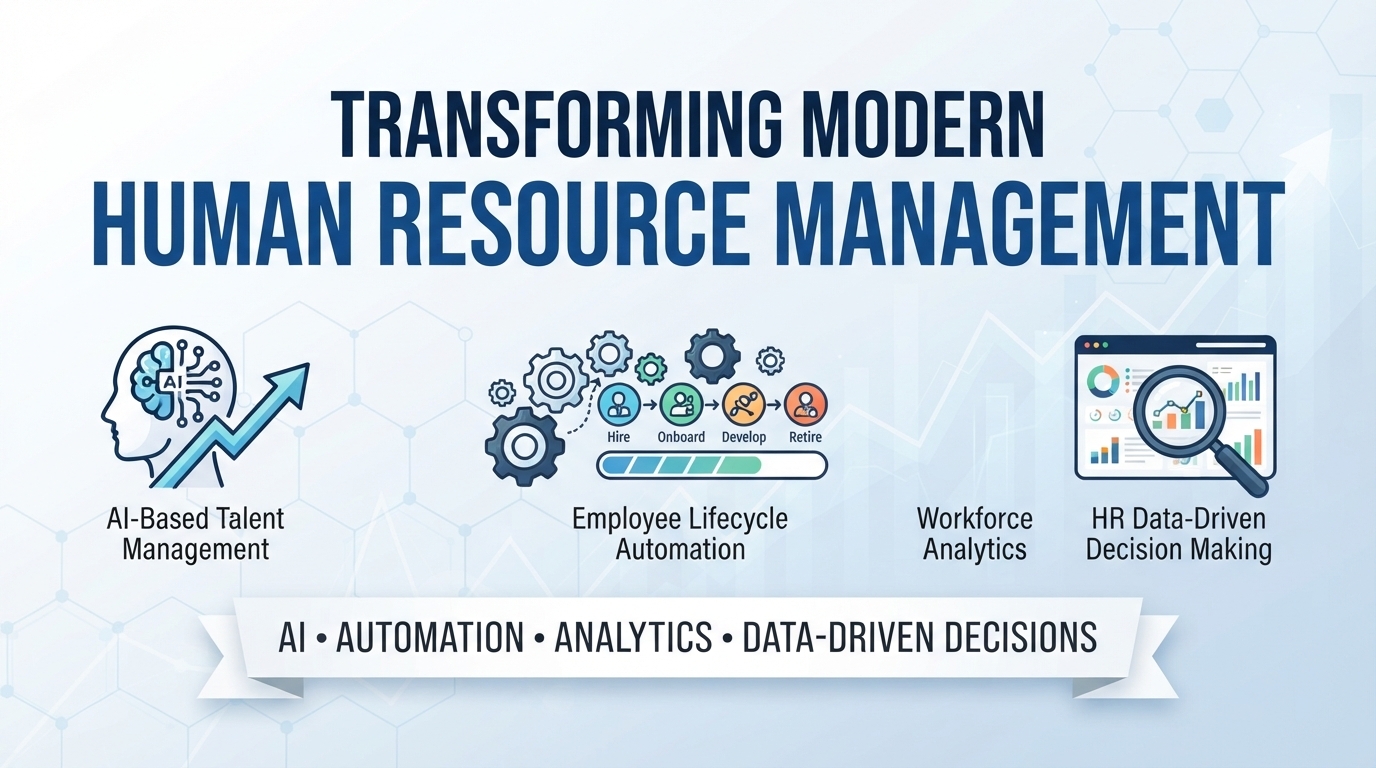
Transforming Modern Human Resource Management
AI-Based Talent Management, Employee Lifecycle Automation, Workforce Analytics Solutions, and HR Data-Driven Decision Making
As organizations continue to embrace digital transformation, Human Resources has evolved from an administrative function into a strategic business partner. By integrating AI-Based Talent Management, Employee Lifecycle Automation, Workforce Analytics Solutions, and HR Data-Driven Decision Making, businesses can improve recruitment, enhance employee experiences, streamline HR operations, and make informed workforce decisions. Together, these technologies create a modern HR ecosystem that increases efficiency while supporting long-term organizational growth.
1. AI-Based Talent Management and Employee Lifecycle Automation
AI-Based Talent Management enables organizations to optimize every stage of talent acquisition and development. Artificial intelligence helps identify qualified candidates, assess employee performance, recommend personalized learning opportunities, and support succession planning.
These capabilities allow HR teams to make faster, more objective decisions while improving the overall employee experience.
Complementing this approach is Employee Lifecycle Automation, which automates routine HR processes from recruitment and onboarding to performance management, career development, and offboarding. Automation minimizes repetitive administrative tasks, improves process consistency, and allows HR professionals to focus on strategic initiatives.
Together, these solutions help organizations:
- ✔ Improve recruitment efficiency and candidate selection
- ✔ Streamline onboarding and employee management processes
- ✔ Enhance workforce productivity and engagement
- ✔ Reduce administrative workload and human error
- ✔ Support continuous employee development
2. Workforce Analytics Solutions and HR Data-Driven Decision Making
Modern organizations generate large volumes of workforce data that can provide valuable business insights. Workforce Analytics Solutions collect and analyze employee information to measure productivity, engagement, retention, and organizational performance.
These insights help HR leaders identify trends, anticipate workforce challenges, and improve workforce planning.
Building on these insights, HR Data-Driven Decision Making enables organizations to make strategic HR decisions based on accurate data rather than assumptions. By combining workforce analytics with real-time reporting, businesses can improve hiring strategies, optimize resource allocation, and strengthen overall workforce planning.
The HR Intelligence Cycle
When integrated, these technologies create a continuous improvement cycle:
This connected approach enables organizations to create more efficient, responsive, and employee-focused HR functions.
3. Business Applications and Strategic Value
Organizations across a wide range of industries are adopting intelligent HR technologies to improve workforce management and maintain a competitive advantage.
Integrating AI-Based Talent Management, Employee Lifecycle Automation, Workforce Analytics Solutions, and HR Data-Driven Decision Making allows businesses to build agile HR strategies that respond quickly to changing organizational needs.
Common Business Applications
These technologies can support organizations in:
- 🎯 Optimizing recruitment and talent acquisition
- ⚙️ Automating HR workflows and administrative tasks
- 🤝 Improving employee engagement and retention
- 📊 Supporting workforce planning with predictive analytics
- 📈 Enhancing performance management and career development
- 💡 Using workforce insights to improve strategic decision-making
To maximize long-term value, organizations should continuously monitor HR performance, maintain high-quality workforce data, invest in employee development, and regularly refine their digital HR strategies.
Conclusion
The future of Human Resources depends on integrating intelligent technologies that improve both operational efficiency and employee experiences. AI-Based Talent Management strengthens talent acquisition and development, Employee Lifecycle Automation simplifies HR operations, Workforce Analytics Solutions provide valuable workforce insights, and HR Data-Driven Decision Making enables informed strategic planning.
By combining these four solutions, organizations can create a modern HR framework that enhances workforce performance, supports better business decisions, improves employee satisfaction, and drives sustainable organizational growth.